Expanding and aligning green freight programs in Latin America
Workshop
Latin America green freight workshop
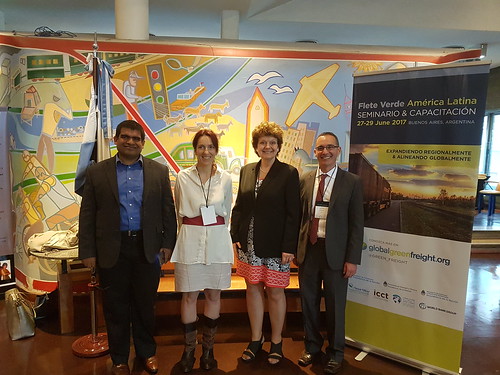
From June 27-29, Argentina’s Ministry of Transportation with the support from Argentina’s Ministry of Energy and Mining, Argentina’s Ministry of Environment and Sustainable Development, the United States Environmental Protection Agency (EPA), the Climate and Clean Air Coalition (CCAC), the International Council on Clean Transportation (ICCT) and the World Bank hosted the “Latin America Workshop on Green Freight Programs” in the city of Buenos Aires, Argentina. During the three-day event, more than 100 attendees met to discuss challenges and opportunities for green freight program development in the region.
During the first day, the opening remarks of Argentinian officials marked the freight sector as a priority to reduce greenhouse gases, mitigate health impacts and increase economic competitiveness. They presented current government initiatives to improve data collection, infrastructure and vehicle technology, and emphasized the importance to collaborate with industry, academia and international organizations to design effective policies. Experts from the EPA, CCAC, ICCT, and the World Bank among others, provided an overview of the programs and tools implemented in other regions such as the North American SmartWay program and the Global Green Freight Action Plan. In a very engaging session, officials from Brazil, Chile, Colombia, Mexico, Peru, and Uruguay shared current and future initiatives to green the freight sector. Key recommendations from the first day included: leverage existing resources to facilitate capacity building; share knowledge and experiences across different countries to harness synergies; promote program harmonization to account for trade integration in the region; and encourage communication across relevant stakeholders.
On the second and third days of the workshop, the EPA provided training on program design and implementation and technology verification. These sessions enabled active participation and exchange of ideas on how to learn from SmartWay’s experience. During breakout sessions, the participants worked in small groups to identify barriers and potential solutions to green freight in areas such as regulation, finance, technology, information and education, industry, and government capacity and resources.
In the end, there was a general consensus to keep the communication and look for mechanisms to share information among the different government agencies and countries; the aim is to share efforts and facilitate the harmonization of green freight programs in the region. Hence, one immediate next step is to find those venues and activities to maintain the collaboration. Additionally, Argentina will implement a pilot program which requires follow-up work, and the event sparked opportunities to expand green freight programs to other Latin American countries.
Organizers: Argentina’s Ministry of Transport, CCAC, ICCT, US EPA