Market analysis and fuel efficiency technology potential of heavy-duty vehicles in China
White paper
Heavy-duty vehicles in China: Cost-effectiveness of fuel-efficiency and CO2 reduction technologies for long‑haul tractor‑trailers in the 2025–2030 timeframe
China is considering options for increasing fuel efficiency and reduce CO2 emissions from freight transportation. This study assesses the future costs of existing and emerging technologies to reduce fuel consumption and CO2 emissions of long‑haul tractor‑trailers in China. Economic impact metrics are investigated, including investment payback period, first-owner and full lifetime fuel savings, and the marginal cost associated with various technology packages under a range of economic assumptions.
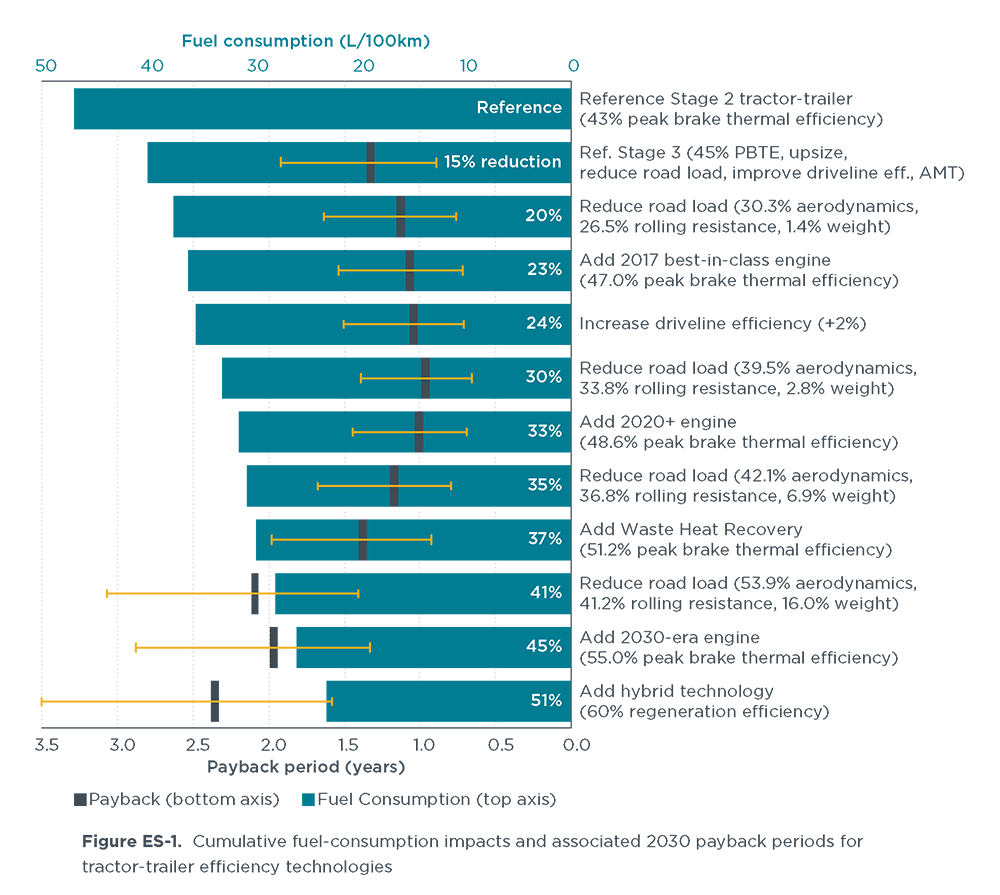
The figure below depicts the estimated fuel-consumption reductions and associated payback periods for evaluated technology packages in 2030. A representative baseline long‑haul tractor with 1.045 trailers costs approximately ¥422,700 in 2016 yuan. Available efficiency technology packages offering moderate fuel-consumption reductions of as much as 35% are projected to cost ¥117,300–¥130,300 in 2025–2030 based on best-available cost data and conventional technology learning assumptions. The potential discounted lifetime fuel savings for these moderate efficiency packages range from ¥478,400–¥1,215,050 per tractor‑trailer. The most advanced technology package offers a 51% distance‑specific fuel-consumption reduction and is estimated to cost ¥326,000–¥333,400 in 2025–2030. But this package would generate lifetime fuel savings of ¥698,900–¥1,775,100 per tractor‑trailer.
The findings from this study have several implications related to fuel-efficiency and CO2 standards:
Available efficiency technologies for long‑haul tractor‑trailers offer fuel savings that greatly exceed the upfront costs of technology and maintenance. Findings indicate that available tractor‑trailer efficiency technology can reduce distance‑based fuel consumption and CO2 emissions by 35% from baseline 2015 Stage 2 technology and deliver payback periods to tractor‑trailer owners that are generally within 1.3 years or less. Based on technology availability, this level of efficiency technology can be widely deployed in the 2020–2025 timeframe.
Emerging advanced efficiency technologies offer more substantial fuel savings and more attractive payback periods over the long term. Technology packages with long‑term road load and engine technologies in the post‑2025 timeframe can achieve a 51% reduction in fuel consumption and CO2 emissions from baseline 2015 Stage 2 technology. Technology-forcing standards and sufficient lead time would be needed to promote the development and deployment of these advanced technologies post-2025.
Tractor‑trailer efficiency technologies’ attractive payback periods persist even in the event of higher technology costs and low fuel prices. The more advanced technology packages, delivering 37%–51% reductions in fuel consumption and CO2 emissions, have payback periods of 0.9–4.0 years, even assuming high technology costs, high discount rates, and low fuel prices. The attractive and robust payback-period findings indicate that there are prevailing market barriers to technology introduction, warranting the introduction of stringent tractor‑trailer efficiency standards.
Tractor‑trailer efficiency technologies offer first‑owner fuel savings that greatly exceed the increased upfront capital and maintenance costs. For typical first owners of a tractor, available efficiency technologies that reduce fuel consumption by 35% offer ¥126,300–¥653,000 in discounted fuel savings over the first five years of ownership and result in benefits that are 2–7 times greater than the upfront technology and maintenance costs, depending on economic assumptions.