
Blog
Grounded (by beef)! A different take on aviation carbon accounting
At the close of 2021, I sat down to ballpark aviation’s contribution to my personal carbon footprint for the year, as I have in previous years. Then, I remembered: due to COVID travel restrictions, I managed to get out of 2021 without ever setting foot on a plane. So, zero aviation greenhouses gases (GHGs) from me this year, and not much to show on a fancy bar chart. It’s a big change from 2018, when flying for work accounted for about three-quarters of my personal carbon footprint, with emissions totaling almost 10 tonnes of CO2.
Not to be denied, I decided to explore the contribution of diet to my GHG footprint and to compare that to the impact of flying. I used this Carbon Brief article to estimate my GHGs from eating meat. Ballpark: my family of three eats about 120 kg of meat per year, in about a 50%/30%/20% split of chicken, pork, and beef. That’s 40 kg per person, so roughly the global average and one-third that of the typical American. Assuming that the beef we consume is half beef herd and half dairy herd (🤷♂️), my meat consumption accounts for a bit over 500 kilograms of carbon dioxide equivalent (kg CO2e) per year.
That’s about a quarter of the 2 tonnes CO2e I generate from energy use, without flying, so fairly large. But it’s small compared to the GHG toll of my work flying in 2019, when I chalked up about 90,000 km in economy class to represent the ICCT at UN meetings, in the process emitting about 7 tonnes of carbon dioxide (CO2). So, my frequent flying for work is about 14 times as bad for the climate as my meat eating.
This comparison is somewhat apples to oranges, though, since it compares aviation CO2 alone to the full set of GHGs from meat consumption, including the potent short-lived climate pollutant methane. A better comparison would be to use an aviation metric that accounts for the full (CO2 + non-CO2) impacts of flying. Scientists believe that co-pollutants like nitrogen oxides, black carbon, and water vapor, plus the aviation-induced cloudiness they help trigger, can warm the climate up to twice as much as CO2 alone. So, as a frequent flier for work, GHGs from flying could have been roughly 40 times more climate-damaging than my meat consumption.
The calculations are rough, but generate a clear conclusion: skipping one round-trip flight could reduce my GHG burden as much as eating no meat for a year, with the actual math depending on the lengths of the trip. And that’s in relatively fuel-efficient economy class. Had I flown business or first class—on average between 2.6 and 4.3 times more CO2 intensive than economy—even short trips look worse for the climate than eating meat.
The map below shows round-trip flights that emit as much climate pollution as eating 40 kg of meat, disaggregated by seating class (economy vs. premium) and CO2 alone vs. accounting for all of the climate impacts of flying.
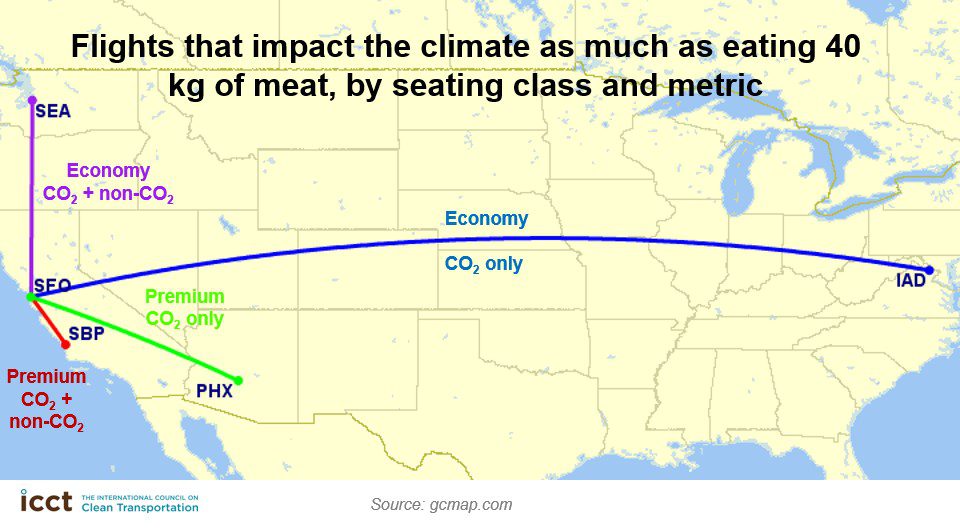
As shown, eating 40 kg of meat damages the climate about as much as a transcontinental flight in economy counting CO2 only (blue line), or an economy trip between San Francisco and Seattle counting both CO2 and non-CO2 climate impacts (purple). The equivalent premium seating trips are even shorter, from San Francisco to Phoenix on a CO2 only basis (green line), and a short 600 km hop from San Francisco to San Luis Obispo (red line) if the full climate damages of flying are accounted for.
In the long-term, we’ll need large scale collective action, in the form of new low carbon aircraft and fuels driven by public policy, in order to address the climate impacts of flying. In the short-term, if like me you are a frequent flier who also eats meat, skipping a trip or two per year is likely to be better for the climate than going vegetarian. Of course, there is no harm, and much to be gained, in doing both!