Blog
Net-zero aviation: How it started and how it’s going
In 2022, the International Civil Aviation Organization (ICAO), the UN agency governing civil aviation worldwide, agreed to a goal to achieve net-zero carbon dioxide (CO2) emissions from international aviation by 2050. This ambitious goal will likely require up to US $5 trillion in investments in clean aircraft and fuels. Governments and industry have begun implementing the agreement. Since that work has started, how’s it going?
The ICCT’s Aviation Vision 2050 report analyzed the technologies and policies needed to achieve net-zero aviation by 2050. The study projected airline CO2 emissions through 2050 under four scenarios:
- Business As Usual (BAU): A continuation of the status quo.
- Action: Coordinated efforts by governments and industry to cap aviation CO2 below 2019 levels by 2050.
- Transformation: Concerted efforts by governments and industry to shift from fossil fuel use starting in 2035 and nearly halve 2050 aviation CO2 compared to 2019 levels.
- Breakthrough: Early, aggressive, sustained government intervention that triggers widespread investments in zero-carbon aircraft and fuels, peaking fossil fuel use in 2025 and zeroing it out by 2050.
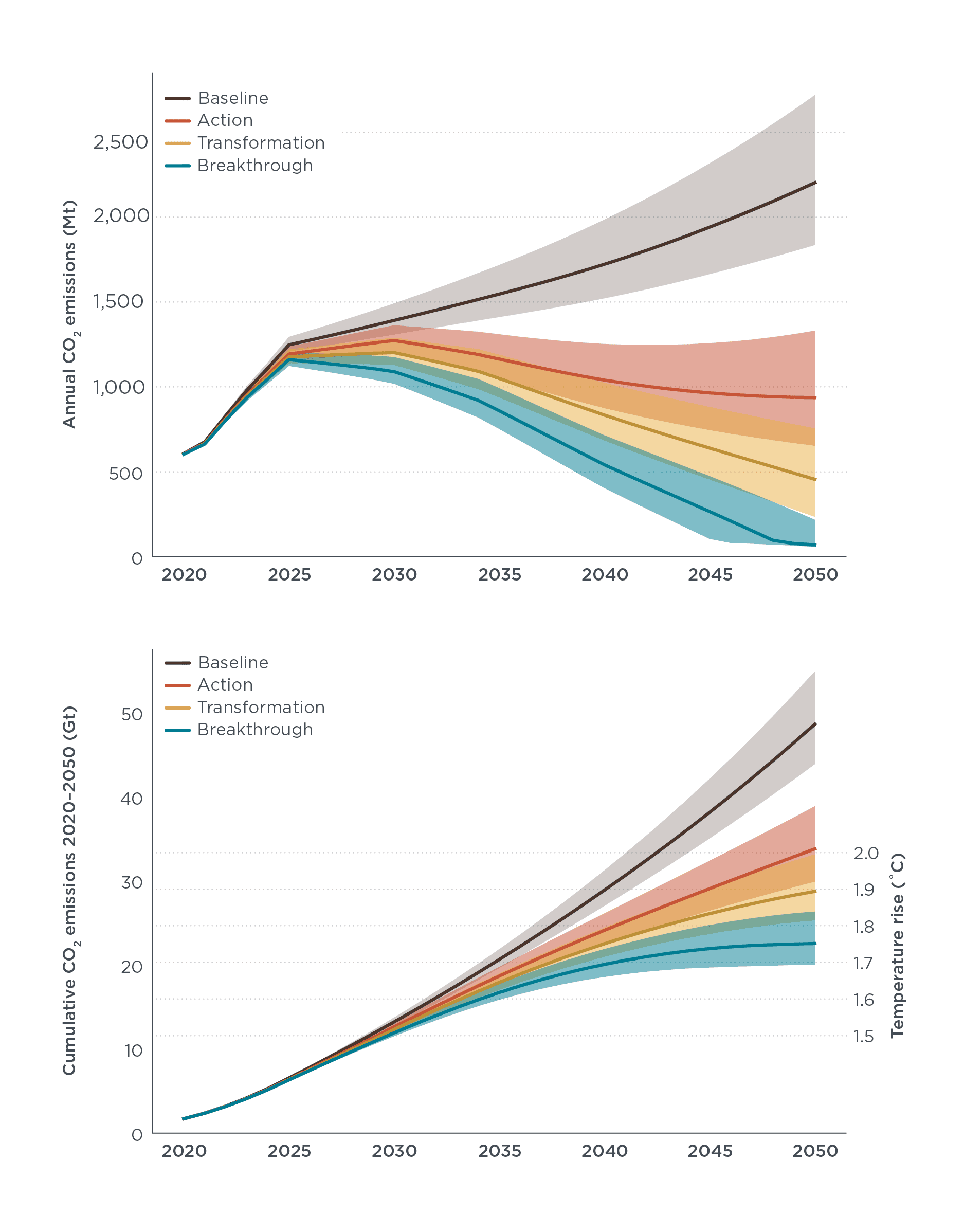
The figure below shows our projections through 2050 of annual CO2 emitted by airlines (top) and cumulative CO2 over time (bottom). The far-right scale on the lower chart shows how cumulative emissions relate to global temperature targets. Under the most ambitious Breakthrough scenario, airlines emit near-zero CO2 by 2050 and hew to an emissions pathway consistent with 1.75 °C, assuming that airlines maintain their 2019 share of CO2 (2.9% on a well-to-wake basis). In contrast, both the BAU and Action cases consume a 2 °C warming carbon budget by 2050, and emissions continue on an upwards trajectory. The Transformation case is largely consistent with a 2 °C budget.
Figure. Well-to-wake global aviation CO2 emissions by scenario and traffic forecast, annual (top) and cumulative (bottom), 2020–2050. The solid lines depict the central traffic forecast, while the shaded areas depict the range between the low and high forecasts.
To understand how the sector is progressing two years later and what additional steps are needed, we need more background on how aviation emissions are calculated. Broadly, we project aviation emissions over time as a product of fuel carbon intensity (g CO2/MJ of fuel), aircraft energy intensity (MJ/revenue passenger kilometer, or RPK), and traffic (RPKs):
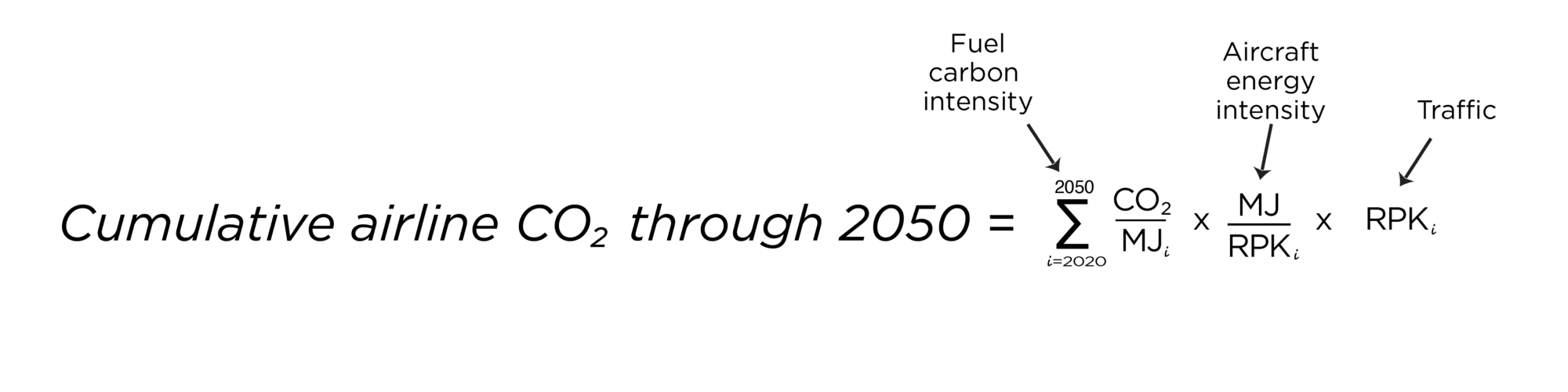
Our report identified key measures that can influence these three factors. Broadly, these include sustainable aviation fuels (SAF), zero emission planes (ZEPs) powered by hydrogen or electricity, efficiency measures, traffic, and economic incentives like carbon pricing. SAFs and ZEPs work to cut fuel carbon intensity, while new efficiency measures like purchasing aircraft and improving load factors reduce aircraft energy intensity over time. Traffic is influenced by numerous factors, including economic growth, airline pricing strategies, and public policies like carbon pricing, which can modulate traffic growth by increasing ticket prices.
With these levers in mind, how are things going for aviation? In short, we’re starting to see some Action, especially in the European Union (EU), but there is no Breakthrough yet in sight.
Legally binding SAF requirements in Europe, Indonesia, and Brazil, along with mandates under development in the United Kingdom and Japan, are consistent with 2% global SAF uptake by 2030. Non-binding goals (including ICAO’s aspirational goal of 6% SAF in 2030, select carrier commitments, and the Inflation Reduction Act tax incentives in the United States) could potentially bring 2030 volumes up to the assumed Action level of 3% SAF by 2030.
Electric aircraft, which we project will potentially cover a small (up to 0.2%) share of aviation RPKs by 2050, have hit turbulence; many startups are pivoting to hybrid electric designs instead. Airbus has rolled back plans to develop a narrowbody hydrogen aircraft and is now focusing on putting a smaller regional aircraft into service by 2035. Generally, these developments are consistent with the expectations of our BAU and Action scenarios, which assume no ZEP penetration.
The International Air Transport Association projects no reduction in the energy intensity of airlines between 2019 and 2024 due to the lingering impacts of COVID-19. Longer-term, Airbus and Boeing are working to develop next-generation narrowbody planes that reduce fuel burn by 20%–25% relative to current (A320neo and 737MAX) aircraft types. This aligns with our Action case, assuming similar technologies would be applied to widebody aircraft soon thereafter.
Post-COVID traffic has rebounded faster than expected; it’s forecasted to have exceeded 2019 levels in the first quarter of 2024, almost a year earlier than anticipated.
Finally, on carbon pricing, the EU Emissions Trading System is the only game in town. It covers about 17% of global passenger aviation CO2 and includes some recycling of revenue to support SAF deployment. Considering the system’s projected 2030 credit price of €147/tonne CO2, a global average carbon price of $25 is dead on our Action case ($17 in 2030, rising to $33 in 2031). So, there is a mix of BAU and Action here.
The table below summarizes how these levers relate to our Vision 2050 scenarios. Overall, airlines seem to be hewing to our Action case, which implies they are cutting CO2 below the BAU scenario but are still on a trajectory to consume a 2 °C warming emissions budget by 2050, with more warming afterwards. In other words, they are not yet on a net-zero pathway.
Table. Decarbonization lever versus Vision 2050 scenario
| Metric | Measure |
Vision 2050 scenario |
|||
| BAU | Action | Transform | Breakthrough | ||
| Fuel carbon intensity (gCO2/MJ) | Sustainable aviation fuel |
✔️ |
|||
| Zero emission planes |
✔️ |
||||
| Aircraft energy intensity (MJ/RPK) | Fuel efficiency |
✔️ |
|||
| Activity (RPK) | Traffic growth |
✔️ |
|||
| Carbon pricing |
✔️ |
||||
Clearly, governments and airlines need to do more to make the aviation sector compliant with the Paris Agreement. But what specifically could they do?
Options include broader moves to obligate SAF use outside of Europe via mandates or low-carbon fuel standards, with robust safeguards for feedstock integrity. Additional efforts would be needed to accelerate the development of short- and medium-haul hydrogen combustion aircraft, which could cover about one-third of global RPKs (a much larger share than regional aircraft). To address energy intensity, ICAO is already working to develop a stronger aircraft CO2 standard by 2025: a proposal that is both ambitious and flexible could guide manufacturer investments toward developing more fuel-efficient aircraft. Finally, governments should consider expanding carbon pricing to cover more airlines, with revenue recycling to support technology development, if they hope to achieve net-zero aviation.
Without progress on these fronts, policymakers may need to think more broadly about how to shift airlines toward a Paris-compliant future. Additional tools that may need consideration include: 1) demand management to reduce traffic growth, 2) carbon capture to take CO2 out of the atmosphere and permanently store it, or 3) work to reduce short-lived climate pollutants, notably contrails (we’ll share more on this soon).
So how’s the race toward net-zero aviation going? It’s off to a decent start in Europe, with the rest of the world mostly still limbering up at the start line. It’s time now for other governments to learn from the European Union’s experience, and for all of us to consider what supplemental measures will be needed.
Author

Dan Rutherford
Senior Director of Research
Related Publications
Analyzes scenarios under which the aviation sector could achieve emissions reductions in line with the goals of the Paris Agreement.